
Institute of National Standards
20.03.23
The Kharkiv Institute of Metrology has a long history. Back in 1901, Dmitri Mendeleev initiated the opening of a calibration chamber in the city, which would unify measurement of weights and distances, primarily to control trade in the Russian Empire. As Kharkiv was the capital of Soviet Ukraine originally, the central authority on calibration in the republic was located here, too. In 1934, the capital was moved to Kyiv, but Kharkiv remained the most important center of control over the accuracy of measurements. The calibration chamber gradually began to conduct research and was reformed into a metrology institute that served not only Soviet Ukraine, but also the southwestern part of Soviet Russia, Soviet Moldova, and the republics of the Caucasus. Until 1955, it was in Kharkiv that Moscow time was checked. After Ukraine gained independence, the institute became one of the most important science centers responsible for accuracy of measurements in our country.
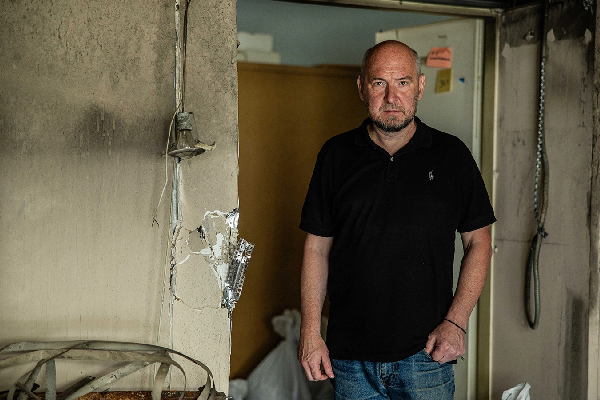
Due to its long history, the institution is located in the very center of Kharkiv, on Myronosytska Street, a few hundred meters from the regional council, so it was heavily damaged when the central part of the city was shelled.

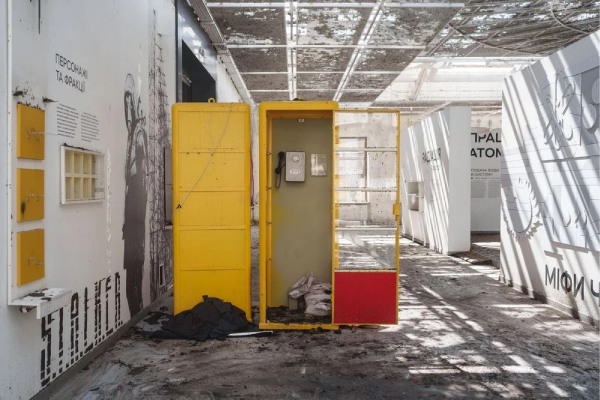
There were no direct hits to the institute, but blast waves and debris from nearby strikes destroyed most of the windows. A blast wave hit the oldest building on one side, broke windows and doors, traveled through the entire building and “came out” on the other side.

Above the entrance of the central building, there is an electronic board showing the most exact Kyiv time, air temperature and atmospheric pressure in the entire country. The glass of this board is broken, but it still works, just like the institute itself.
We talked to the director, Pavlo Neiezhmakov. In his office, the windows are boarded up with OSB (is a board made of wood chip material that is pressed using both pressure and high temperature), the table has cuts all over it, and the glass doors of a cabinet with diplomas and awards are held together with tape.

Pavlo compares metrology to air — no one can see it, but you cannot live without it even for five minutes. For example, to synchronize the movement of trains, airplanes or bank transactions, you need precise timing. The institute has several atomic clocks — the so-called group measurement, with a margin of error of one second per 1.3 million years. With the help of Internet servers, several million users synchronize with this time every day.
In addition, to produce various items, you require accurate, internationally recognized weights. Under this condition, products can be exported to other countries without additional paid certifications. An error in the measurement of electricity, oil, and gas on a national scale can cost millions, which makes metrology a highly valuable science.

The institute became an important scientific center after World War II. In the 1960s, it worked on measuring the speed of light. The results obtained in the institute are among the most accurate in the world. They also held measurements of the fundamental constant — the gyromagnetic ratio (is a physical value equal to the ratio of the magnetic moment of a quantum particle to its total angular momentum. The magnetic moment characterizes the interaction of a body with the magnetic field, and the angular momentum — the value and direction of the rotational movement of the particle) of the proton, whose value affects the measurement accuracy of the electric current and the ultra-high temperature of plasma in the thermonuclear reactor. All these research findings were recognized by the global metrological community.
In Soviet times, the institution actively worked for the defense industry. The popular FED cameras were created at this institute as a military technology for aerial photography. They also developed devices that measure distances up to ten kilometers with an error of five millimeters, devices for absolute measurement of the acceleration of Earth's gravity, systems for the convergence of satellites with spaceships, devices that identify large objects underwater, analyzing fluctuations of water surface.
All these technologies are based on ultra-high accuracy, which is ensured by a system of standards (etalons), against which all measuring devices are calibrated. After the collapse of the Soviet Union, most of the standards remained in Russia, so the Kharkiv Institute of Metrology concentrated on the development of standards for our country.
Pavlo conducted a study that proved the economic feasibility of the national system of standards. Applying for verification and calibration services to foreign institutions is much more expensive.

Of the 77 national standards, 52 were created, maintained and studied by this institute. Each standard has its own keeper who watches over it and studies it.

Under the influence of various factors, standards can change and, therefore, lose their quality, so they are stored in special conditions. For example, the kilogram standard is stored under a bell jar in the basement, with a special air conditioning system, on a concrete table that is not connected to the foundation of the building (so that the measurements are not affected by vibration). Weight calibration is carried out at night, when the subway does not run. Since 2018, world metrology uses an equation including Plank’s constant instead of the physical standard of the kilogram in the form of a kettlebell, but it is more convenient to use the old method for calibration.

The standard of the electrical resistance unit is very complex special equipment that uses liquid helium to create a space temperature of 1.2 degrees Kelvin. The room where the equipment is stored is also specially air-conditioned and completely metal-clad to minimize electromagnetic exposure.

A standard of one meter length is obtained with the help of laser equipment, which is also placed in a special chamber located on a separate foundation.

Temperature standards (from 0 to 1084 degrees Celsius) are obtained using equipment that records the exact melting temperature of water and the melting or solidification points of various ultrapure metals.
The accuracy of electromagnetic radiation frequencies is checked in closed (so-called anechoic) chambers lined with special absorbers. One of them was produced at the institute itself. Such a chamber would cost EUR 1.5 million if purchased, but Kharkiv scientists made one for UAH 50,000 (about EUR 1280 as of March 2023).

Among the latest developments is the lumen standard, i.e. the unit of light output. This standard became particularly useful after the spread of LED light bulbs. An incandescent light bulb provides a stable light output until it burns out. In an LED bulb, though, it changes over time. Accordingly, it is impossible to make a stable LED standard for measuring light output. To work around this, scientists use an incandescent light bulb imitating the spectral characteristics of an LED lamp using special glass filters. This way, the error in measuring the light output of these lamps reduced from 5–7% to 1%. The institute tested various light bulbs from the Ukrainian market, and found deviations of 20% in some manufacturers’ products.
Most of the standards are stored underground, so they were not affected by the shelling and explosions. The atomic clock is located on the first floor. Several fragments ended up in the room where it is located, but the clock was not damaged and did not stop its work even for a second.
Now, the plan is to move it to the basement, and in case of issues with the Internet, the institute already has access to a Starlink.

On February 25, an employee of the institution, Demian Kravchenko, who lived in an area which was under constant shelling, moved to the institute. He supervised the operation of the atomic clock 24/7 during the most difficult times, when the institution barely functioned. On April 17, Demian was killed during the shelling of the institute’s territory with a cluster bomb.

In addition to the premises on Myronosytska, the institute also has premises in Lyptsi on the northern outskirts of Kharkiv. There, a unique system of reference standards for calibrating GPS receivers, antennas, and total stations which are only available in four other countries, are stored. The building in Lyptsi also hosts 10 standards of ionizing radiation used to calibrate X-ray machines and radiation therapy equipment, as well as two standards of hardness.
Russians occupied Lyptsi back on February 24, 2022. The base of the institute is located at a height from which the occupiers shelled Kharkiv until their retreat in September. In Lyptsi, there was no power, no food supply, people lived off exchanging products. The Russians captured workers of the institute and tortured them with electric current, but fortunately, they survived and are already in Kharkiv. Pavlo has not yet visited the premises there, because he is waiting for the demining of the base area.

Not even taking Lyptsi into account, the institute in Kharkiv suffered damage amounting to about UAH 70 million (about EUR 1.8 million as of March 2023). Eight six-ton containers of broken glass were taken out; the heating system was destroyed by the frost.
About 140 of the institute's 220 employees are now in Kharkiv. Many evacuated to other regions, ten young women went abroad with their children. Using international contacts, Pavlo helped them with employment in metrological institutes in their temporary places of residence so that they could exchange experience and establish scientific contacts with European specialists during their stay abroad.

Considering the specifics of standards storage, they are very difficult to evacuate. Of course, the equipment can be put away and transported, but there can be no accuracy without special conditions. That is why the institute is making plans to secure the standards in place.
Despite all the difficulties, the institution continues its activities. After downtime in March and April, in May, customers gradually began to apply for verification and calibration services. In October, the institute reached about a half of the previous year’s scope of work. Scientific activity does not stop either. The scientists are working on a system of accurate long-distance measurement as part of the European projects GeoMETR, DOSEtace, RevStdLED, RealMass, attempting research on machine processing of measurement results for systems working without human intervention (such as car autopilot). The Kharkiv Institute of Metrology has every chance for successful development. It is critical for business and for European integration.
Accurate measurements based on standards can be used to understand how the physical world works — but Russia’s standard barbarism is impossible to understand.
This report has been developed within the project supported by the Public Affairs Section of the U.S. Embassy in Ukraine. The views of the authors do not necessarily reflect the official position of the U.S. government.